A keyword sitting in a spreadsheet does nothing until it becomes a ranking article. An autonomous SEO workflow closes that gap by using AI agents to run the full pipeline - research, briefing, drafting, optimization, and publishing - with humans stepping in only to set strategy and approve output. It works like an assembly line where each stage hands off cleanly to the next, so a target phrase turns into a live, optimized page without you copy-pasting between five tools.
Below we compare the tools and setups worth considering in 2026, starting with our own approach at Seoapp.ai. The goal is simple: fewer manual hours, more consistent publishing, and content that ranks in Google and gets cited by ChatGPT, Perplexity, and Gemini. If you have wondered whether SEO is dead or just evolving, this is the evolving part.
What an autonomous SEO workflow actually covers
An autonomous SEO workflow is a system where AI agents handle the repetitive stages of content production - keyword research, brief creation, writing, on-page optimization, internal linking, and publishing - while you retain control over direction and final approval. It is not one button that spits out a website. It is a chain of connected steps, each producing a checkable output. This is what SEO automation looks like when it moves past scheduling posts and starts making reasoned decisions at every stage.
The full pipeline usually breaks down like this:
- Keyword research and clustering - finding the phrase and its related queries.
- Briefing - defining intent, structure, and target length.
- Drafting - generating the article body.
- Content optimization - matching on-page signals to what ranks.
- Publishing - pushing WordPress drafts or live posts through the CMS.
- Internal linking - connecting the new page to existing ones.
- Tracking - measuring rankings and AI visibility over time.
Common failure points are predictable: thin content that says nothing new, missing internal links, and no measurement loop. Skip any of those and automation just produces more mediocrity faster. A good system bakes the fixes in.
Seoapp.ai: our autonomous SEO agent for Google and AI search
At Seoapp.ai we built an autonomous SEO agent that watches two things most tools ignore together: your Google rankings and your visibility inside large language models (LLMs) like ChatGPT, Perplexity, and Gemini. It publishes optimized articles daily, so businesses that cannot spare hours on SEO still ship consistent, ranking content.
We describe the philosophy as autopilot with a cockpit. The agent runs the routine work day and night, but you keep the dashboard: what topics to prioritize, what tone to hit, what to approve. The Seoapp AI layer handles the mechanical judgment - which cluster to target next, whether a draft matches intent - so your input stays at the strategy level.
- Daily automated content aligned with Google's helpful content guidelines.
- Tracking that covers both classic SERPs and AI answer engines (seo geo in one view).
- Hands-off publishing that turns a keyword into a finished article.
For whom: companies and founders who want search and AI visibility without running a manual SEO process. We go deeper on the 2026 setup in our guide to autonomous SEO in 2026, and you can start free to see the pipeline run on your own domain.
Agentic SEO stacks: Ahrefs, MCP servers, and custom agents
Some teams prefer to assemble their own agentic SEO stack rather than use a single platform. Agentic SEO means using LLMs not just to draft text but to act - query data, build small tools, and adapt when something fails. In practice this often means connecting Ahrefs for keyword and backlink data, an LLM for reasoning, and MCP servers (Model Context Protocol connectors) so the agent can reach live data and your CMS directly. The LLM is the reasoning core: it decides which Ahrefs query to run, reads the result, and adjusts the brief without a human rewriting the prompt each time.
This route is powerful and flexible. It also demands engineering time and ongoing maintenance, which is why it suits technical teams more than solo marketers.
| Setup | Best for | Standout | Effort to run |
|---|---|---|---|
| Seoapp.ai | Businesses wanting hands-off Google + AI visibility | Tracks LLM citations, daily publishing | Low |
| Ahrefs + custom agents | Teams with data + dev resources | Deep backlink and keyword data | High |
| MCP-connected LLM agents | Developers building bespoke pipelines | Live data access, tool building | High |
| CMS-native automation | WordPress-first publishers | Direct WordPress drafts control | Medium |
The trade-off is straightforward: build-your-own gives control but eats hours; a managed agent trades some control for speed. We see teams start custom and migrate to a managed layer once the maintenance tax gets old.
From keyword to published article: how the automation flows
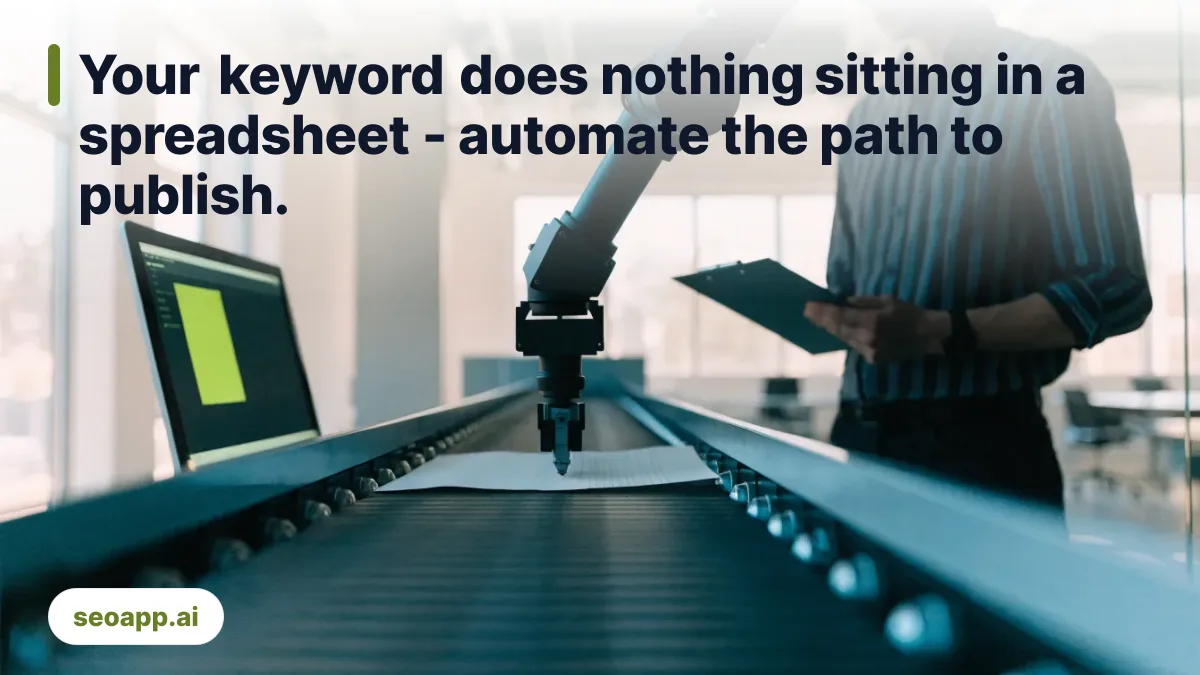
Here is what a working automated SEO run looks like day to day. Say your target is a mid-competition phrase. The agent pulls related keywords, clusters them by intent, and drafts a brief with the right structure and word count. Then it writes, optimizes against on-page signals, and prepares the post for publishing.
Automation should prioritize high-impact tasks, not just produce volume.
What automation reliably handles well:
- Turning briefs into WordPress drafts without manual copy-paste.
- Refreshing and updating existing pages on a schedule.
- Adding internal links between related articles.
- Logging every change for an audit trail.
What still needs a human: strategy, brand voice, and the final yes. The pipeline standardizes production so quality stays even, but you decide what gets published. The machine scales the boring parts; you own the calls that carry risk.
Choosing the right autonomous SEO workflow for your business
Picking a setup comes down to how much control you want versus how much time you have. There is no single best answer, only the right fit for your resources. Before committing, run each option through a few honest questions.
- Do you have dev capacity? No developers means a managed system beats a DIY agent stack every time.
- Do you need AI visibility, not just Google? If ChatGPT and Perplexity citations matter, pick a tool that tracks how LLMs surface your brand - many classic SEO platforms still do not.
- How fast do you need to publish? Daily cadence favors managed automation; occasional articles can survive a lighter setup.
- Can you integrate your CMS? Confirm the tool pushes to WordPress or your platform, plus connects Google Analytics and Search Console for real monitoring.
A common mistake is automating publishing before automating measurement. If you ship 30 articles a month but cannot see which ones rank or get cited, you are flying blind. Connect tracking first, then let volume scale on top of a system that tells you what works. That is the difference between a genuine production engine and just an expensive content firehose.
Autonomous SEO workflow checklist: 7 steps before you go hands-off
Before you hand your content pipeline over to an agent, walk through this checklist once. Every point below is something the workflow should handle without you - if one is missing, that gap becomes your new manual job.
- Keyword discovery - the agent finds long-tail queries itself instead of waiting for your list.
- Search intent check - every topic maps to a question a real buyer actually asks.
- Brief and outline - headings answer the query directly; clear structure is also what LLMs quote.
- Writing and on-page SEO - title, meta description, internal links and schema are part of the draft, not an afterthought.
- Publishing - the article lands in your CMS automatically; slow publishing quietly eats content ROI, as we showed in our breakdown of the hidden cost of slow publishing.
- Indexing and tracking - sitemap updates, Search Console monitoring, position tracking.
- The update loop - articles with impressions but weak positions get refreshed, not abandoned.
How long until an autonomous workflow shows results?
The honest answer: the workflow publishes in minutes, but Google needs weeks. On a new domain expect the first stable impressions after 4-8 weeks and meaningful clicks after 3-6 months; established domains move faster. We keep two separate write-ups on this: how long automated SEO content takes to rank and a transparent log of 30 days of hands-off publishing with real numbers.
Two metrics tell you the workflow is healthy long before traffic arrives: growing impressions in Search Console and a rising count of queries your domain appears for. If both curves move, the pipeline works - the rest is authority and time. And since more buyers now ask ChatGPT or Perplexity instead of Google, track your brand there too - AI visibility monitoring is the second half of the same job.
Frequently asked questions
Is SEO dead or evolving in 2026?
SEO is evolving, not dead. The mechanics changed: alongside ranking in Google, brands now compete to be cited inside AI answers from ChatGPT, Perplexity, and Gemini. Quality content and clean technical signals still win - they just get consumed by both people and the LLMs behind those answer engines now.
What is an autonomous workflow?
An autonomous workflow is a process where AI agents complete a chain of tasks with minimal human oversight, acting and adapting on their own. In SEO, that means the system researches, drafts, optimizes, and publishes while a person sets strategy and approves the output rather than doing each step manually.
What is an SEO workflow?
An SEO workflow is the connected sequence of steps that turns a target keyword into a ranking page: keyword research, briefing, writing, content optimization, publishing, internal linking, and performance tracking. A structured process keeps quality consistent and speeds up production compared to ad-hoc work.
What is the 80/20 rule in SEO?
Automation pays off most when it prioritizes those high-impact tasks before chasing raw volume.
If your keywords are still stuck in a spreadsheet, the fastest move today is connecting one real tracking source - Search Console or your CMS - so you can see what a published article actually does. From there, layering an autonomous SEO workflow on top stops feeling risky and starts feeling like leverage. We built Seoapp.ai to run that full pipeline daily while you keep the cockpit; try it free on your own domain and watch a keyword become a live, cited article without the manual grind.
Rate this article
People don't just Google anymore - they ask AI 🚀
Grab traffic from Google and AI at once. seoapp.ai writes content that ranks and gets cited by AI - so you stay ahead of the competition.
Try seoapp.ai →