Most SEO teams spend hours on competitor research every month, only to see rivals move again before the report is even finalized. Competitive SEO analysis techniques are methods used to study who ranks for your target queries, determine why they succeed, and identify gaps you can exploit. The most effective techniques include backlink analysis, keyword gap mapping, content depth comparison, traffic estimation, and AI citation tracking. Below, you'll find techniques that actually impact rankings, tools worth investing in, and an approach that automates the entire process.
What are competitive SEO analysis techniques?
Competitive SEO analysis involves studying rival domains that rank for your target keywords to identify weaknesses you can exploit and gaps you can fill. It answers one question: why do they outrank me, and how can I close the gap? Done effectively, a single analysis can reveal dozens of quick wins that would otherwise take months to discover through trial and error.
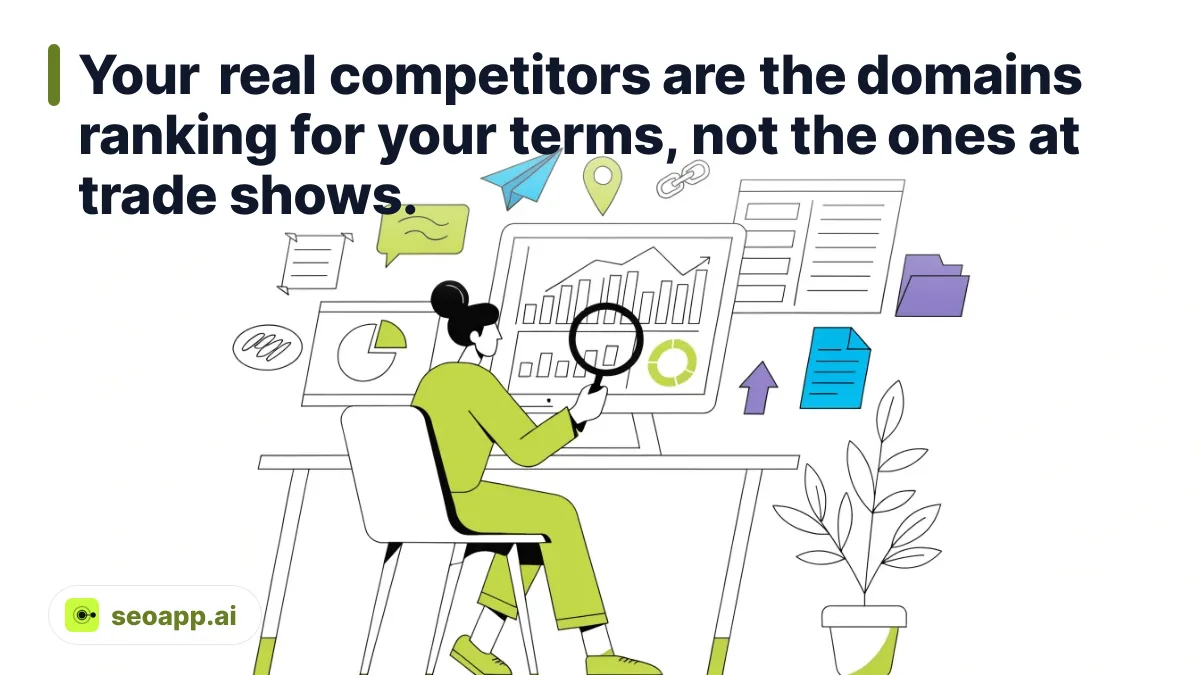
Your SEO competitors aren't always your business competitors. For example, a local law firm might compete in search against a national legal blog or a directory it never considers commercially. The domains taking your clicks are those ranking on page one for the terms you target.
The core techniques fall into five categories:
- Backlink analysis - identifying who links to your rivals and why
- Keyword gap analysis - discovering terms they rank for that you don't
- Content depth comparison - assessing how thoroughly they cover a topic
- Traffic estimation - determining which pages drive their organic visits
- AI visibility tracking - checking if ChatGPT, Perplexity, and Gemini cite them
Master these five areas to get a complete picture. Omitting AI visibility means you're auditing a 2020 version of search.
How do you run a backlink and keyword gap analysis?
Backlink analysis and keyword gap analysis yield quick results because they provide a ready list of actions.
Step 1. Pull the backlink profiles of your top three ranking competitors. Examine Domain Rating (DR), a metric estimating authority on a 0-100 scale. A rival with DR 65 and 400 referring domains can explain why you're stuck on page two.
Step 2. Filter their links for those you could realistically earn - guest posts, resource pages, industry directories, journalist mentions. Ignore what you can't replicate.
Step 3. Run a keyword gap report. It lists queries where competitors rank in the top ten and you don't rank at all. These are your fastest content wins because demand is already proven.
Step 4. Sort the gap list by search volume against keyword difficulty. Low difficulty plus decent volume equals a page you can write this week and rank within a month.
A thorough analysis also highlights on-page signals worth emulating - header structure, internal links, and schema that help a rival's page rank. Instead of guessing topics, you build a calendar around terms competitors already profit from.
Which tools are best for competitive SEO analysis?
The best tools cover backlinks, keyword gaps, and rank tracking, and increasingly, AI citations.
| Tool | Best for | Standout feature | Plan |
|---|---|---|---|
| Seoapp.ai | Hands-off analysis + publishing | Scans site, rivals, and AI mentions, then writes fixes | Paid, free trial |
| Semrush | All-in-one research | Deep keyword and backlink databases | Paid |
| Ahrefs | Backlink analysis | Large link index, DR scoring | Paid |
| Google Search Console | Real performance data | Actual clicks, impressions, positions | Free |
| Screaming Frog | Technical crawling | Full on-page and site structure audit | Free tier + paid |
Seoapp.ai is our autonomous SEO agent. It scans your site, competitors, and queries, benchmarks the difference, then acts on it - not just a dashboard, but a system that writes and publishes the content the gap analysis calls for. The radar constantly checks whether ChatGPT, Perplexity, and Gemini cite your brand, which classic tools ignore.
Semrush and Ahrefs remain reference suites for manual research. They provide extensive keyword and link databases, provided you have an analyst to interpret them. Google Search Console is the free source of truth for your own clicks and positions; every workflow should start there. Screaming Frog handles the technical crawl and on-page checks - broken links, missing meta descriptions, duplicate titles - that data-only tools miss.
How does automation change competitive SEO analysis?
Automation transforms competitive SEO analysis from a monthly project into a daily loop that runs while you work. Most guides miss this shift - they teach the techniques but leave execution to you.
The old process: pull competitor data, build a spreadsheet, spot gaps, brief a writer, wait, publish, repeat next quarter. By the time the article ships, the landscape has changed. Our agent compresses that cycle. It continuously scans keywords and rivals, detects opportunities, then writes and publishes up to 30 optimized articles a month on autopilot - one complete, ready article each day.
Why the daily rhythm wins:
- Speed - gaps get filled in days, not the following quarter
- Consistency - one publish per day beats a batch every three months
- Coverage - rankings rise as the system learns from Google Search Console
- AI-readiness - content is structured so language models can cite it
Teams that used to pay agencies for this exact loop have replaced them and dropped paid ads at the same time. For the full workflow, our guide on how a seo agent works while you sleep breaks down each step.
How do you turn competitor gaps into published wins?
You turn gaps into wins by pairing analysis with a publishing engine, so every insight becomes a live page instead of a note in a document.
Consider a hypothetical B2B software firm that finds 40 keyword gaps in an audit. Done manually, that's forty briefs, forty writer handoffs, and months of lead time. With an automated agent, those same gaps feed a content calendar that fills itself daily, in the languages of the company's customers and in its own brand tone.
The workflow that actually closes gaps:
- Run the gap analysis to get proven-demand keywords
- Prioritize by difficulty versus volume
- Generate content built to rank and to be cited by AI
- Publish automatically to WordPress or Shopify
- Track real clicks and positions, then let the system relearn and adjust
This is where our advanced content analysis techniques come in - the same analysis that finds the gap shapes content deep enough to hold the position once you rank, with on-page optimization baked in from the first draft. For a side-by-side on approaches, our breakdown of Seoapp ai vs seo tooling walks through the tradeoffs, and our piece on how to stay ahead of daily publishing rivals shows the routine in full.
Frequently asked questions
How can businesses benefit from competitive SEO analysis?
Businesses use it to find proven-demand keywords, replicate winning backlinks, and prioritize content that already earns traffic for rivals. Since two-thirds of clicks go to the top five results, closing the gap directly grows organic visits without guesswork or wasted content spend.
What tools are best for competitive SEO analysis?
Seoapp.ai adds autonomous analysis plus publishing and AI citation tracking, which classic tools don't cover. Semrush and Ahrefs lead for manual keyword and backlink research, Google Search Console is the free source for your own performance data, and Screaming Frog handles technical crawls plus on-page audits.
How does Seoapp.ai enhance competitive SEO analysis?
Seoapp.ai scans your site, competitors, and queries, benchmarks the gaps, then writes and publishes up to 30 optimized articles a month automatically. It also checks whether ChatGPT, Perplexity, and Gemini cite your brand, turning analysis into published, AI-ready pages without manual work.
Start with a free Google Search Console review to see your real positions, run one keyword gap report against your top competitor, and publish the first page it points to this week. If the manual loop keeps stalling, let Seoapp.ai run the whole cycle - scan, benchmark, write, publish - and free your week for the strategy the software can't decide for you.
Rate this article
People don't just Google anymore - they ask AI 🚀
Grab traffic from Google and AI at once. seoapp.ai writes content that ranks and gets cited by AI - so you stay ahead of the competition.
Try seoapp.ai →