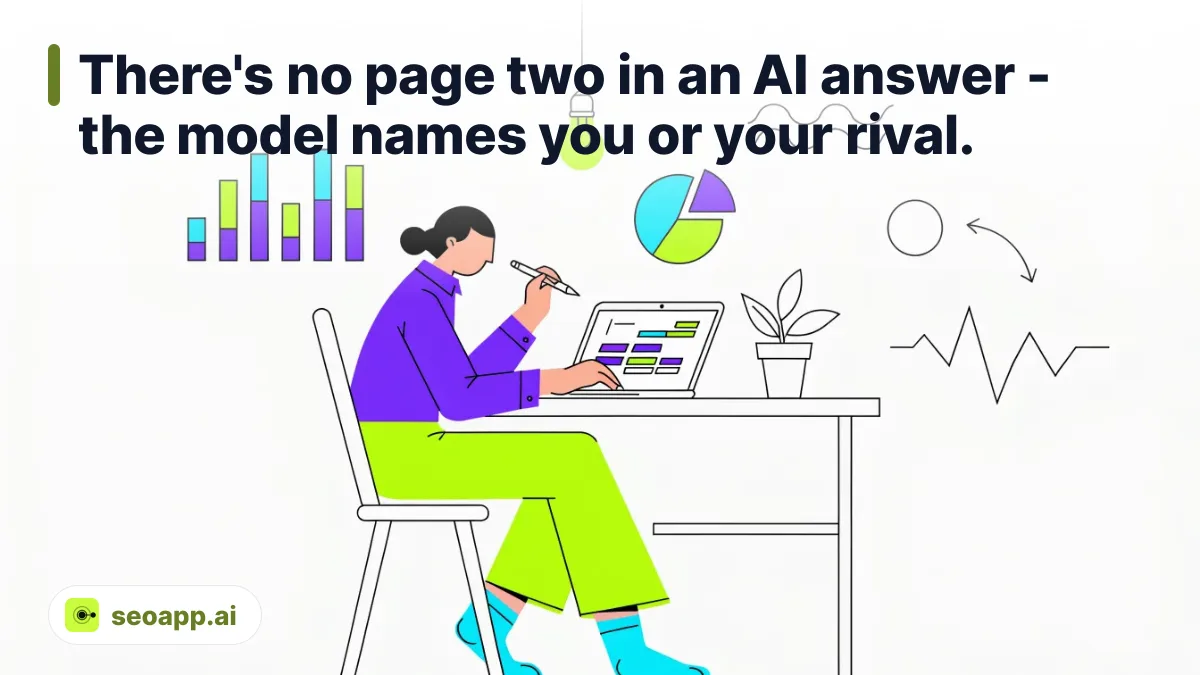
Ask ChatGPT "what's the best SEO automation tool" and look at the names it gives you. If your brand isn't there, you've got an AI visibility problem. AI models visibility is how often and how prominently your brand, product, or content shows up inside answers generated by large language models like ChatGPT, Gemini, Claude, and Perplexity. Think of it as the new ranking, except there's no page two to hide on. The model either names you or it names a competitor.
In 2026 the game changes. You stop chasing blue links and start earning citations inside AI answers. That means structuring content so models can pull it out and quote it, building the trust signals they weigh, and checking whether the answer engines actually mention you. What follows are the strategies, tools, and measurement methods that actually move the needle.
What is AI models visibility and why does it matter now?
This metric measures how often your content is referenced, cited, or surfaced within answers produced by large language models (LLMs) - AI systems trained on huge amounts of text to generate human-like responses. Instead of counting where you sit on a results page, LLM visibility counts how many times a model repeats your brand name or pulls your content into a direct answer.
The shift is happening fast. If the model skips you during that conversation, you never make the shortlist.
Here's what sets it apart from classic SEO. LLMs don't crawl and rank pages one by one like Googlebot does. They synthesize information from many sources at once, then hand the user a single answer. The line between Google and AI ChatGPT keeps blurring as both mix search with generative answers.
Being cited decides whether you're the source an answer engine quotes, or the brand it never mentions.
You're not optimizing for a position anymore. You're optimizing to be the quotable, trusted source a model reaches for.
How can businesses enhance visibility in AI models?
Businesses enhance their presence by publishing clear, well-structured, trustworthy content that language models can easily extract and cite. The aim is simple: make your pages the cleanest possible source for a given question.
The tactics that carry the most weight in 2026:
- Answer questions directly in the first two sentences. Models lift the opening lines of a section. Bury your answer under throat-clearing and it gets skipped.
- Use atomic definitions. A single sentence in the format "X is ___" is exactly what a model quotes back to a user.
- Add first-hand data and expertise. Unique data, original research, and clear authority push models to cite you over generic pages.
- Structure with FAQs, lists, and tables. These formats get pulled into answers far more often than dense prose.
- Publish consistently. Coverage across a topic is what earns repeated mentions.
That's the exact problem our agent Seoapp.ai solves - it drafts and publishes a long, optimized article every day, up to 30 a month, so your topical coverage grows without a full content team.
What strategies improve AI models visibility in 2026?
The strongest 2026 strategy combines three things: optimizing for natural language processing, monitoring AI mentions continuously, and closing content gaps before competitors do.
Here's a sequence that works:
- Audit your current AI presence. Run the prompts your customers would ("best [your category] tool," "how to solve [your problem]") across ChatGPT, Gemini, and Perplexity. Note whether you show up and who gets cited instead.
- Optimize existing pages for extraction. Rewrite openings as direct answers, add definitions, break walls of text into lists and tables.
- Fill topic gaps. Every question you don't answer is a citation you're handing to a rival.
- Track weekly. A page cited this month can drop when a competitor publishes something sharper.
- Feed the loop. Use what earns mentions to shape the next round of content.
Traditional SEO metrics don't capture this AI-driven search behavior.
Which AI models matter, and how does their coverage work?
The four models that most affect brand presence right now are ChatGPT, Google Gemini, Perplexity, and Claude - and each treats sources a little differently.
| Model | Primary role | How it surfaces sources | Why it matters for visibility |
|---|---|---|---|
| ChatGPT | Largest answer surface | Synthesizes into answers; cites when browsing | Sheer reach - most consumer AI queries land here |
| Google Gemini | Search-integrated AI | Feeds AI Overviews and AI Mode in Google | Blends with the search results you already track |
| Perplexity | Citation-first research | Shows numbered sources on nearly every answer | Best place to earn visible, clickable citations |
| Claude | Reasoning and long-form | Cites when connected to search or tools | Growing share in professional and technical queries |
Perplexity is the most citation-transparent, which makes it the clearest early signal of whether your content is quotable. Gemini overlaps with classic search, so gains there often show up in both places - one optimized page can win twice. We dig into these differences in our guide on Perplexity and Gemini visibility, with a broader breakdown of AI models improving business here.
Don't optimize for a single model. A well-structured page - direct answers, definitions, clean formatting - tends to perform across all four at once, because they all reward extractability.
What does a real improvement look like?
A real improvement looks like moving from zero AI mentions to being cited again and again for your core topics within a few months of consistent, structured publishing.
Take a common scenario. A mid-size software company runs a scan and shows up in zero AI answers for its main category - every prompt cites two larger rivals instead. That "absent" starting point is more common than most brands assume.
The fix follows a pattern:
- Month 1: Publish direct-answer content targeting the exact questions buyers ask AI. Fix thin, unstructured pages.
- Month 2: First citations appear, usually in Perplexity, since it exposes sources most openly.
- Month 3+: Mentions spread to ChatGPT and Gemini as retrieval signals catch up to the fresh, trusted content.
We built this into our workflow because we lived the pain. As one of our team put it: "We built Seoapp.ai because we were sick of the choice - pay an agency a fortune, or lose six hours per article." One user summed up the outcome: "I replaced my agency with one Seoapp.ai." The point isn't the tool. It's that consistent, extractable, trusted content changes the answer a model gives.
What are the benefits of optimizing for natural language processing?
Optimizing for natural language processing (NLP) means writing content the way people actually phrase questions to an AI, so the model recognizes your page as the direct match.
First, you match conversational queries. Nobody types "SEO tool pricing" into ChatGPT - they ask "how much does an automated SEO tool cost?" NLP-friendly content mirrors that phrasing. Second, extraction gets easier: clear definitions, question-based headings, and short direct answers are the shapes an LLM pulls into a response. Third, you cover intent, not just keywords - answering the why and how around a term.
The practical benefits:
- Higher citation rate because your phrasing matches the query
- Better performance across multiple models at once, since they all favor clarity
- Content that stays useful even as ranking algorithms change
Optimizing for NLP is the most durable investment in LLM visibility. It aligns content with how these systems actually work, rather than chasing a single ranking factor.
Frequently asked questions
How can businesses ensure their content is cited by AI models?
Businesses can ensure their content is cited by AI models by focusing on clear, structured content that models can easily extract. This includes providing direct answers in the opening lines, using atomic definitions, and incorporating FAQs and comparison tables. Adding first-hand data and subject-matter expertise builds trust signals that models weigh when choosing what to cite. Consistent publishing across a topic can then earn repeated mentions.
How can companies track and improve their AI visibility?
Companies can track and improve their AI visibility by auditing which prompts they already appear in, rewriting pages for extractability, and monitoring results weekly. This is crucial as presence shifts when new content is published. Filling topic gaps before competitors do is also essential to maintaining visibility.
Why is optimizing for natural language processing beneficial?
Optimizing for NLP is beneficial because it increases the citation rate by aligning content with how people phrase questions to AI. It also enhances performance across multiple models, as clarity is rewarded by ChatGPT, Gemini, and Perplexity. Additionally, it ensures content remains useful even as ranking algorithms evolve.
The fastest way to know where you stand is to run the prompts your customers use and see who the models name. If it isn't you, the fix is systematic: direct answers, clean structure, trusted data, and enough coverage that the models keep reaching for your content. Our agent handles that loop daily - scanning your competitors and AI mentions, then publishing optimized articles that build the exact signals answer engines reward. Start with a scan to see which 147+ keywords and AI gaps are yours to win, and strengthen your AI models visibility for good.
Rate this article
People don't just Google anymore - they ask AI 🚀
Grab traffic from Google and AI at once. seoapp.ai writes content that ranks and gets cited by AI - so you stay ahead of the competition.
Try seoapp.ai →