Most businesses treat content like a chore. Six hours per article, and it still misses the keywords Google actually ranks for. Automated content generation flips that math. It uses AI and software to research, draft, optimize, and publish with barely any manual work, turning a weekly slog into daily output. For SEO, the shift runs deeper than speed. This article breaks down what automated content creation is, how it changes SEO, where it breaks without oversight, and how to compare the tools.
What is automated content creation and how does it work?
Automating content is the use of AI, machine learning, and natural language processing to generate, optimize, and publish material with minimal human involvement. Natural language processing (NLP) is the branch of AI that lets software read and produce human language. Instead of a person researching, drafting, and formatting by hand, software takes over the repetitive parts.
The process runs in stages. Here is a typical automated workflow:
- Keyword detection. The system scans search queries, competitor pages, and ranking gaps, then flags topics worth writing about.
- Outline and draft generation. AI builds a structured outline and writes a first version with the target keyword, related terms, and real questions.
- Optimization. The draft is refined for search intent, headings, internal links, and readability.
- Publishing. The finished piece goes live automatically on a CMS like WordPress or Shopify.
- Monitoring. Rankings, competitor moves, and AI citations are tracked so the next piece is smarter.
In 2026 the focus has moved from spitting out text to automating the whole production line. A paragraph generator solves 10% of the work. An agent that publishes and measures solves the rest.
How does automated content creation transform SEO for businesses?
Hands-off production transforms SEO by letting a business publish consistently, cover far more keywords, and react to ranking data without a full content team. Search engines reward sites that publish fresh, relevant material on a steady schedule - exactly what manual workflows struggle with.
The gains show up in a few concrete ways:
- Volume without burnout. A daily article beats one rushed post a week. More indexed pages means more entry points for search traffic.
- Keyword coverage. These systems surface long-tail queries a human might never spot.
- Faster reaction. When rankings shift or a competitor moves, the system adjusts the next brief instead of waiting for a quarterly review.
- AI visibility. Fresh, well-structured content is what ChatGPT and Perplexity cite when they answer questions.
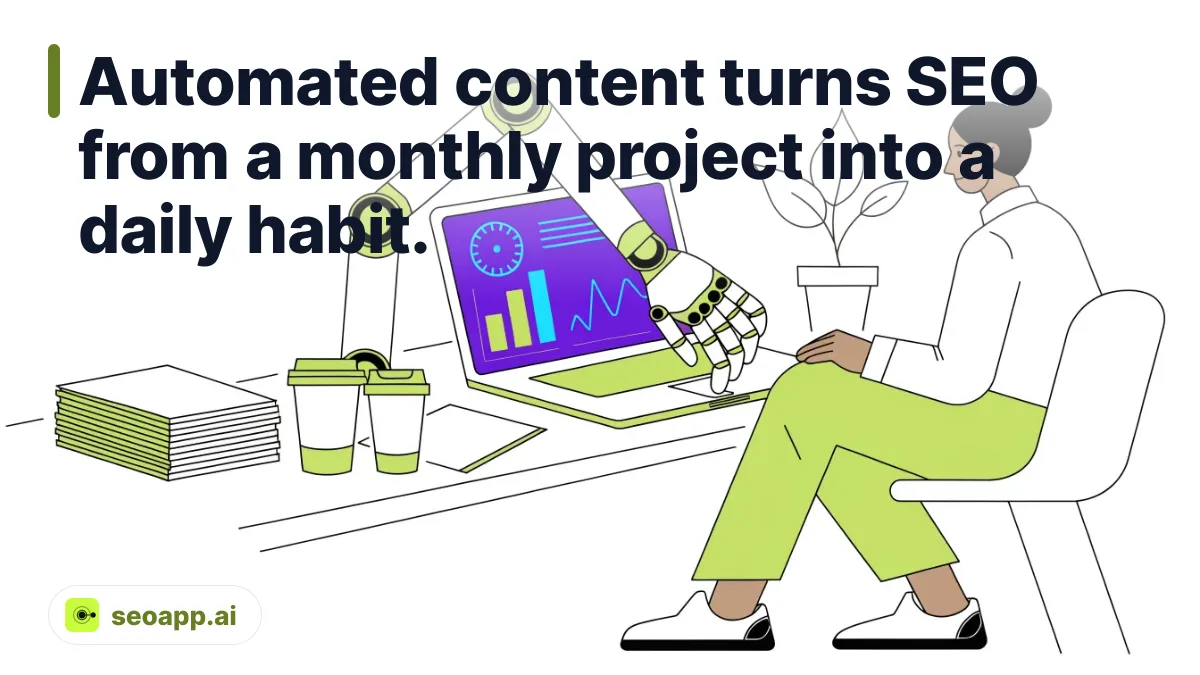
This approach turns SEO from a monthly project into a daily habit that compounds.
At Seoapp.ai, the AI content creation agent writes and publishes one long, optimized article every day and learns from Google Search Console, so each new piece is shaped by what already works. That feedback loop is the real transformation - not the writing, but the system that keeps improving on its own. A SaaS founder publishing 30 pieces a month builds topical depth that used to take an in-house team a full quarter.
What are the real benefits and efficiency gains?
The biggest benefit is reclaimed time and cost. Automation handles research, formatting, and publishing, so people can focus on strategy and brand.
Beyond cost, the efficiency gains stack up:
- Personalization. AI can shape content for different audiences and languages while holding your brand voice.
- Fewer errors. Automated formatting and optimization checks catch mistakes that slip past tired writers.
- Scale. Producing 30 articles a month by hand is unrealistic for most teams; on automation it is routine.
For the full setup, see automated content publishing: streamline your SEO workflow 2026. The point of automation is not to write more for its own sake. It is to reduce the hidden cost of SEO work that swallowed afternoons and still left gaps in your keyword map.
What are the challenges and limits of automated content tools?
The main challenge is that automation without oversight produces content that ranks poorly, sounds generic, or drifts from the facts. AI is strong at repetitive, data-driven material and weak at emotionally rich or highly original writing. Hand it full control with no review, and you end up with thin, forgettable pages.
Watch for these limits:
- Quality drift. Without human checks, drafts can be accurate but flat, or fluent but wrong.
- Brand voice. A model that hasn't learned your tone will sound like every other AI blog.
- Factual risk. Generated content can repeat errors or invent specifics - a real concern for anything published unreviewed.
- Duplication. Poorly configured tools recycle the same angles across posts, which search engines notice.
The fix isn't to avoid automation. It's to build guardrails: editorial rules, brand-voice training, and a quick review layer before anything critical goes live. We cover those safeguards in 4 essential SEO content creation checks before publishing. Treat the AI as a fast junior writer, not an unsupervised publisher, and the risks shrink.
How do automated content creation tools compare?
These tools split into three categories: workflow connectors, generators, and full SEO agents. The right pick depends on how much of the pipeline you want handled and how tightly it ties to your rankings.
| Tool type | Example | Best for | What it does |
|---|---|---|---|
| Full SEO agent | Seoapp.ai | Businesses wanting hands-off SEO | Writes, publishes, tracks rankings, competitors, and AI citations - daily |
| Workflow connector | Zapier, Activepieces | Teams stitching apps together | Automates publishing and distribution across platforms |
| Content generator | AI writing tools | Drafting help | Generates text drafts that still need optimization and publishing |
The difference that matters is scope. Our full agent closes the loop - it detects keywords, writes, publishes to WordPress or Shopify, and checks whether ChatGPT, Perplexity, and Gemini cite your brand. A generator, by contrast, only gives you a draft. A connector like Zapier moves that draft between apps but has no idea if it will rank. That end-to-end coverage separates real SEO automation from a stack of disconnected point tools.
A generator writes a page; an SEO agent decides which page to write, publishes it, and measures if it worked.
Instead of one task, Seoapp.ai runs the whole SEO team in one system - content, ranking checks, competitor analysis, and AI visibility monitoring every month. For the automation-first perspective, see automated article publishing: boosting efficiency and SEO.
Frequently asked questions
How does automating content benefit SEO?
It enables consistent publishing, wider keyword coverage, and faster reaction to ranking changes. Search engines reward sites that publish fresh, relevant content regularly, and automation makes that cadence sustainable. It also produces the structured pages that AI search engines like Perplexity prefer to cite.
What are the challenges of using automated content tools?
The main challenges are quality drift, weak brand voice, factual errors, and accidental duplication. AI handles data-driven content well but struggles with original or emotionally rich writing. Human oversight - editorial rules and a review layer before publishing - is essential to keep quality and accuracy high.
How does Seoapp.ai's approach differ from others?
Seoapp.ai runs the entire SEO workflow in one system rather than a single task. It detects keywords, writes and publishes an optimized article daily to WordPress or Shopify, tracks rankings and competitors, and checks whether ChatGPT, Perplexity, and Gemini cite your brand. It also learns from Google Search Console, so each article is shaped by what already ranks.
Automated content creation works best when you stop thinking of it as a text machine and start treating it as a system that publishes, measures, and improves. The businesses that win pair steady output with real oversight. If you're tired of choosing between a pricey agency and lost afternoons, try running a full SEO cycle on autopilot with us and watch how quickly consistent publishing moves your rankings and your AI citations.
Rate this article
People don't just Google anymore - they ask AI 🚀
Grab traffic from Google and AI at once. seoapp.ai writes content that ranks and gets cited by AI - so you stay ahead of the competition.
Try seoapp.ai →