Can you hand your website's SEO to an AI agent and walk away? Yes, but only with the right guardrails. Autonomous SEO is safe for a business website when the tool lets you review changes, respects Google's helpful content guidelines, and keeps you in control of what gets published. The automation isn't the risk. Handing publishing rights to a system with no oversight and no off switch is.
Here's what autonomous SEO actually does, where the real risks sit, and which tools give you both hands-off convenience and enough control to sleep at night.
What is autonomous SEO and how does it work?
Autonomous SEO is the use of AI agents to plan, execute, and refine search optimization tasks-keyword research, content publishing, technical fixes-with minimal human input. Older tools only recommended changes. An autonomous system deploys them.
The loop usually runs like this:
- Data extraction. The agent performs SERP data extraction, pulling ranking positions, competitor pages, and search demand.
- Analysis. Using semantic intelligence, it maps topics and gaps against what actually ranks.
- Content creation. It generates AI-generated content aligned to search intent.
- Publishing. With one-click publishing or direct CMS integration, the article goes live.
- Refinement. The agent monitors results and adjusts-continuous optimization.
Agentic AI closes that loop.
Autonomous SEO isn't about removing humans-it's about removing the repetitive work that never needed a human in the first place.
Is autonomous SEO safe for a business website?
Yes, autonomous SEO is safe for most business websites, provided you use a tool that keeps you in the loop and doesn't touch your code without permission. The danger sits in two places: content quality and unsupervised technical changes.
Take content first. Google's helpful content system rewards genuinely useful pages and penalizes mass-produced filler.
The technical side is trickier. Let an agent rewrite meta tags or restructure URLs across a live site with no review, and things break fast. If a tool only offers automated redirects with zero visibility, walk away.
Safe autonomous SEO comes down to three things:
- You can review or approve content before it goes live
- The tool respects your existing site structure
- There's a clear log of every change made
Which autonomous SEO tools are worth comparing in 2026?
Here are the autonomous SEO platforms worth a serious look, each taking a slightly different angle.
1. Seoapp.ai
Our platform is an autonomous SEO agent that analyzes your Google rankings and your visibility across AI models like ChatGPT, Perplexity, and Gemini-then publishes optimized articles daily. It's built for businesses that want to become visible in Google and AI answers without hiring a team, using the autopilot with a cockpit approach: the agent works while you sleep, but you see what it does.
- Daily AI-generated content tuned for both search and AI citation
- Tracks ranking positions and AI visibility in one dashboard
- One-click publishing to your CMS
- Built to keep you visible in Google and in LLM answers
For who: Small and mid-sized businesses that lack SEO time or staff. Try it at Seoapp.ai or read our SEO agent for business.
2. Mergeflo
Mergeflo automates the full SEO workflow, from keyword research to publishing. According to the Mergeflo autonomous SEO platform, it integrates directly with CMS like Webflow and WordPress to remove manual steps and cut down on large teams or agency retainers.
- End-to-end workflow automation
- Direct Webflow and WordPress integration
- Built with AI search visibility in mind
For who: Teams that want to replace a manual publishing pipeline.
3. Sedestral
Sedestral is an agent-based AI tool that optimizes sites automatically. The Sedestral guide to agent-based SEO tools frames these agents as systems that manage the whole optimization loop with little manual intervention.
- Site-wide crawling and automated on-page fixes
- Analyzes hundreds of on-page metrics per page
- Continuous, agent-driven optimization
For who: Sites needing ongoing technical and on-page tuning at scale.
| Tool | Main focus | Publishing | Best for |
|---|---|---|---|
| Seoapp.ai | Content + AI visibility | One-click / daily | Businesses without an SEO team |
| Mergeflo | Full workflow | Direct CMS | Teams replacing manual pipelines |
| Sedestral | Technical + on-page | Automated | Ongoing site-wide optimization |
How do you use autonomous SEO safely, step by step?
Start small, keep control, then scale once you trust the output. Rushing to full autopilot on day one is where businesses get burned.
- Connect and observe. Link your site and let the tool run analysis only-no publishing yet. Read what it finds.
- Approve the first batch. Turn on content generation but review each piece before it goes live. Check facts, tone, and links.
- Loosen the reins. Once quality is consistent, allow scheduled publishing while you spot-check weekly.
- Monitor both channels. Watch Google rankings and AI visibility. Predictive SEO and competitor benchmarking flag shifts before they hurt.
- Keep the log. Review the change history monthly so nothing happens on your site that you can't explain.
AI tools process millions of data points in milliseconds. That's why they beat manual work at spotting trends. But speed without review is how thin content sneaks in. Scalable workflows mean volume with quality control, not volume instead of it.
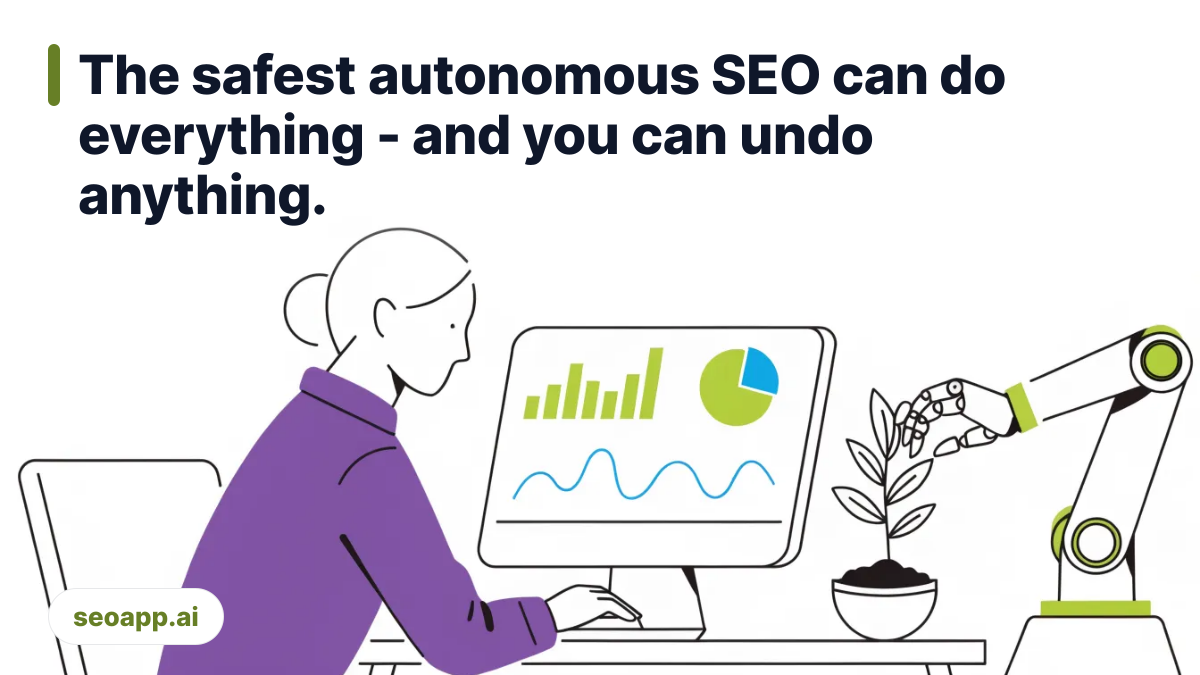
The safest autonomous SEO setup is one where the AI can do everything-and you can undo anything.
What are the four types of SEO and where does AI fit?
The four types of SEO are on-page, off-page, technical, and content-and AI now touches all four. Understanding this helps you judge what a tool can safely automate.
- On-page SEO: titles, headings, internal links, keyword placement. Highly automatable and low-risk.
- Technical SEO: site speed, crawlability, structured data. Automatable, but review changes before they hit a live site.
- Content SEO: creating pages that match intent. This is where personalized and AI-generated content deliver most, if quality is checked.
- Off-page SEO: backlinks and authority. Least automatable-real relationships still matter, and no safe tool should fake links.
Is SEO going away with AI? No. The tasks change, but the goal-being findable when people search-is stronger than ever, especially now that AI answers cite sources. Winners treat autonomous SEO as an agent that improves output, not a magic button. Off-page authority and human judgment still carry weight AI can't replace.
Frequently asked questions
What is automated SEO?
Automated SEO is using software to handle repetitive optimization tasks-keyword tracking, meta tag updates, content publishing-without manual work each time. Autonomous SEO goes further: the AI agent decides what to do and executes it, closing the loop rather than just flagging suggestions.
Can I do SEO by myself?
Yes, especially the basics: good content, clear titles, fast pages, helpful answers to real questions. The hard part is consistency and scale over months. That's where an autonomous tool helps-it keeps the routine work running daily so you don't drop off after week three, where most solo efforts stall.
Is SEO going away with AI?
No. AI is changing how people search and how answers appear, but websites still need to be crawlable, relevant, and authoritative to be found and cited. Being the source AI quotes is the new prize, which makes structured, trustworthy content more valuable than before.
Will autonomous SEO get my site penalized by Google?
Not if the content is genuinely useful. Google penalizes spammy, mass-produced pages, not AI-assisted ones. Use a tool that lets you review output, publishes accurate and relevant articles, and follows the helpful content guidelines, and you stay on the safe side.
Weighing a tool right now? Run one in observe-only mode for two weeks before letting it publish a single word. You'll see exactly how it thinks, catch weak content early, and scale up only once quality earns your trust. Autonomous SEO is safe when you keep a hand on the wheel-so pick a platform that shows its work. That's why we built ours around a cockpit, not a black box.
Rate this article
People don't just Google anymore - they ask AI 🚀
Grab traffic from Google and AI at once. seoapp.ai writes content that ranks and gets cited by AI - so you stay ahead of the competition.
Try seoapp.ai →