Ask ChatGPT "what SEO tool should I use" and it names a few brands. Ask Google the same question and you get a ranked list of blue links. AI in SEO lives right where those two behaviors meet: using machine intelligence to speed through traditional search work while shaping content so answer engines like ChatGPT, Perplexity, and Google's AI Overviews actually recommend you.
Two jobs are happening at once. One is the grind: keyword research, technical audits, drafting. The other is newer. It's about getting cited inside AI-generated answers, where nobody clicks a link at all. This guide covers both. Concrete tools, real workflows, the numbers that matter. If you run a business and want to be visible in Google without living inside a spreadsheet, start here.
What AI in SEO actually means (and the two problems it solves)
AI in SEO is the use of machine learning and natural language processing to analyze search behavior, produce content, and win visibility across both classic search engines and generative answer tools. Most people only grasp half of that.
The first half is automation. Google processes 8.5 billion searches per day, and the manual labor behind ranking has always been the bottleneck. AI shrinks hours of keyword research, technical audits, and content briefing into minutes. This is where SEO automation earns its keep. Instead of a human copying data across five tabs, a model runs the whole prep loop unattended. According to BrightEdge, machine learning reshaped how search engines rank results, starting with Google's own RankBrain years ago.
The second half is adaptation. AI-powered search engines chase intent and context, not pure keyword indexing. Ask Perplexity a question and the tool reads what you meant, pulls facts from a few trusted pages, and answers directly. No ten blue links. You're no longer only optimizing for a crawler. You're optimizing to be quoted.
How AI is used in SEO: from keyword research to technical audits
AI touches nearly every stage of the workflow. Four areas see the biggest lift.
- Keyword research and search intent: AI clusters thousands of queries by intent, not just volume, spotting which searches signal buying, which signal curiosity, and where intent is shifting month to month.
- Content creation: Generative AI drafts outlines, briefs, and first passes. Humans refine for accuracy and voice. This is the "content scaling" layer, where quality control matters most.
- Technical audits: AI scans for broken links, crawl issues, slow pages, and internal link gaps in real time, catching problems before rankings drop.
- Content gaps: By comparing your pages against top competitors, AI flags topics you never covered but should own.
According to Siteimprove, AI-powered SEO tools sharply cut the time needed for audits and keyword analysis. The value isn't that AI writes for you. Hook it up to Google Search Console and tools can watch performance live, reacting to ranking movement the day it happens instead of at the next monthly review.
Optimizing for AI answer engines: SearchGPT, Perplexity, and AI Overviews
Ranking on page one no longer guarantees traffic, because zero-click searches keep climbing. Google's Search Generative Experiences, SearchGPT, and Perplexity answer plenty of questions on the results page itself. The user reads the summary and never visits your site.
So the goal changes. You want to be the source the AI quotes. That skill has a name: generative engine optimization, sometimes shortened to GEO or AEO (answer engine optimization). It's the practice of structuring content so AI models can extract and cite your facts easily.
What actually earns citations:
- Direct answers. Open sections with a clear one-sentence answer. Use FAQs and short bulleted lists so models can lift a clean fact.
- Topical authority. Build deep content clusters around your core subjects instead of scattered one-off posts.
- Traditional foundations. Most AI citations still pull from pages that already rank well. Ranking and getting cited aren't separate games; one feeds the other.
We wrote a fuller breakdown in visible in Google, because the tactics for classic ranking and AI citation keep overlapping. Nail the structure once and you serve both.
Is SEO going away with AI? The honest answer
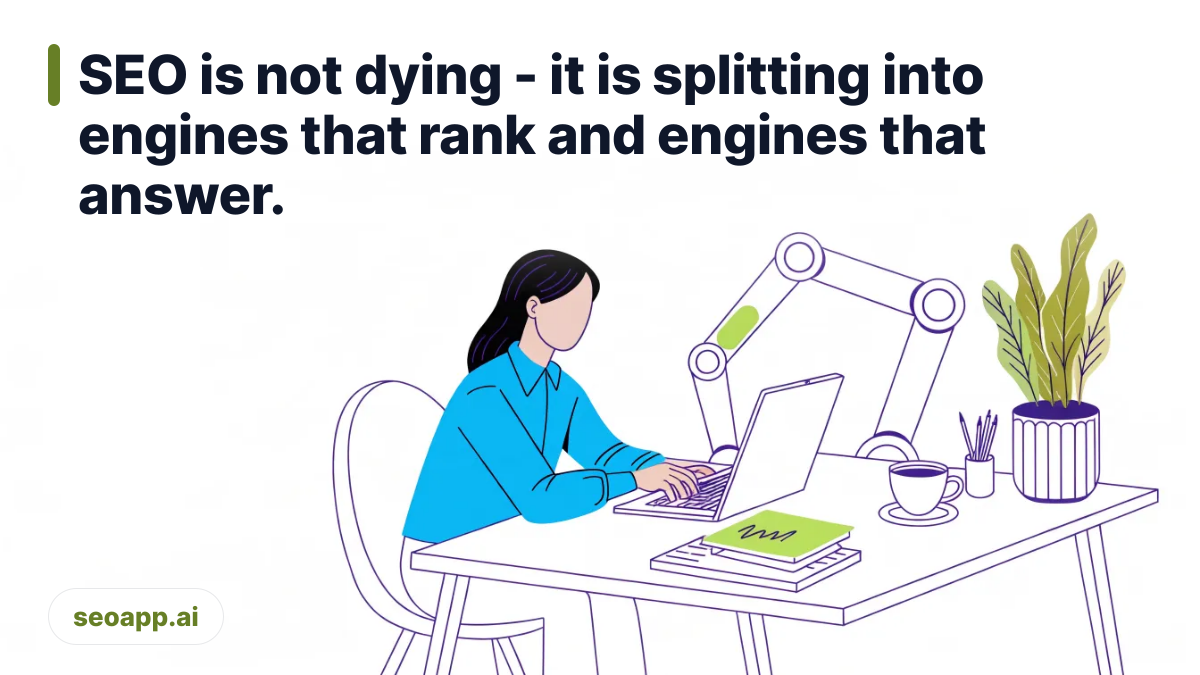
Short version: no, but the job description changed. SEO is splitting into optimizing for engines that rank and engines that answer.
The fear makes sense. If AI Overviews answer questions directly, why would anyone click? Two reasons keep SEO alive. First, generative AI is projected to deliver $460 billion in incremental marketing productivity over the next decade, which means budget is flowing into search, not away. Second, AI still needs source material. Every answer it gives is built from someone's content. If it isn't yours, it's a competitor's.
That ratio keeps output fast without letting quality slide into generic sludge that neither users nor Google reward. The skills that survive are strategy, editorial judgment, and reading user intent. Those never automated away. They just got more valuable.
AI-powered SEO tools compared: what to actually use in 2026
Here's a straight comparison of tools worth knowing. Our own platform sits first because it's built for exactly the audience this guide serves: businesses that want results without doing the SEO work themselves.
| Tool | Best for | Standout feature | Setup effort |
|---|---|---|---|
| Seoapp.ai | Businesses wanting hands-off SEO + AI visibility | Autonomous agent that ships optimized articles daily and tracks ChatGPT, Perplexity, and Gemini rankings | Very low |
| SEO.ai | Teams doing keyword-to-content in one tool | Auto-publishing to WordPress, Webflow, Shopify | Low |
| Semrush | Full-stack SEO teams | Deep keyword and competitor datasets | Medium |
| Google Search Console | Every site owner | Free real-time performance data direct from Google | Low |
Seoapp.ai is our autonomous SEO agent. Our platform analyzes your Google rankings and your visibility inside AI models, then publishes daily optimized articles automatically. This is SEO automation at its fullest: you aren't briefing writers or running audits by hand; the agent does the loop. For a deeper feature walkthrough see Seoapp ai, and if you're weighing options, our vs autoseo 2026 comparison lays out the trade-offs. Businesses evaluating a full SEO agent for business usually care most about how little supervision it needs.
The other tools each earn their place. SEO.ai automates keyword research, content creation, and backlink work, with flexible auto-publish or review-first modes. Semrush remains the reference dataset for competitive research. Google Search Console is free and should be connected on day one.
Frequently asked questions
How can AI be used in SEO?
AI handles keyword research, meta tag generation, technical audits, and content drafting at scale. It scans search trends, internal link gaps, and shifts in user intent quickly, then flags what to fix. The most effective setup lets AI do the heavy prep while humans refine strategy and final content.
Is SEO going away with AI?
No. SEO is evolving rather than disappearing. AI changes how content is created and where visibility happens, but search demand keeps growing and every AI answer still needs source content. The winners optimize for both traditional ranking and AI citation.
What is the 30% rule for AI?
It ensures output is fast without sacrificing the quality signals that search engines and AI models reward.
Does AI work for SEO?
Yes, when used with human oversight. AI-powered SEO tools cut audit and research time dramatically and can spot technical issues or content gaps in real time before they hurt rankings. The risk is treating AI output as final; unedited content tends to rank and convert poorly.
The real shift isn't that AI writes articles. It's that being visible now means winning two audiences at once: Google's crawler and the answer engines your customers increasingly ask instead. Handle that manually and you'll fall behind teams who automated it. The simplest next step is to connect your site to an agent, let it run for 30 days, and measure whether your citations and rankings move. If you want that loop handled end to end, start a trial with Seoapp.ai and watch the first daily articles publish before you decide.
Rate this article
People don't just Google anymore - they ask AI 🚀
Grab traffic from Google and AI at once. seoapp.ai writes content that ranks and gets cited by AI - so you stay ahead of the competition.
Try seoapp.ai →