An SEO agent ranking analysis is the automated process where an AI system audits your search positions, works out why competitors outrank you, and applies fixes without a person driving every step. In practice, the agent connects to sources like Google Search Console, scrapes top-ranking pages, clusters keyword intent, and flags what Google actually rewards. Spent an afternoon exporting rank reports into a spreadsheet and still felt behind? This is the shortcut. Below we break down the factors these agents evaluate, which platforms handle it well, and how to pick one. We build one of these agents ourselves, so we'll be straight about what automation does and doesn't cover in 2026.
What is an SEO agent ranking analysis and how does it work?
An SEO agent ranking analysis is an autonomous evaluation of how a site performs in search, where an AI agent tracks positions, benchmarks rivals, and recommends or applies changes with minimal human input. The word "agent" matters. A tool shows you data; an agent decides what to do with it and acts. That's the heart of SEO automation-the software doesn't wait for you to read a chart, it moves on the finding.
The workflow runs in a loop:
- Connect data - pulls live keyword, backlink, and domain metrics through an API (Google Search Console, the SE Ranking API).
- Scrape the SERP - reads top-ranking pages for each query to model the structure and depth Google favors.
- Cluster intent - natural language processing groups queries by meaning, so "cheap running shoes" and "budget trainers" land in one cluster.
- Diagnose gaps - compares your page against winners: missing subtopics, thin sections, weak internal linking.
- Act or recommend - some steps run automatically, others wait for approval.
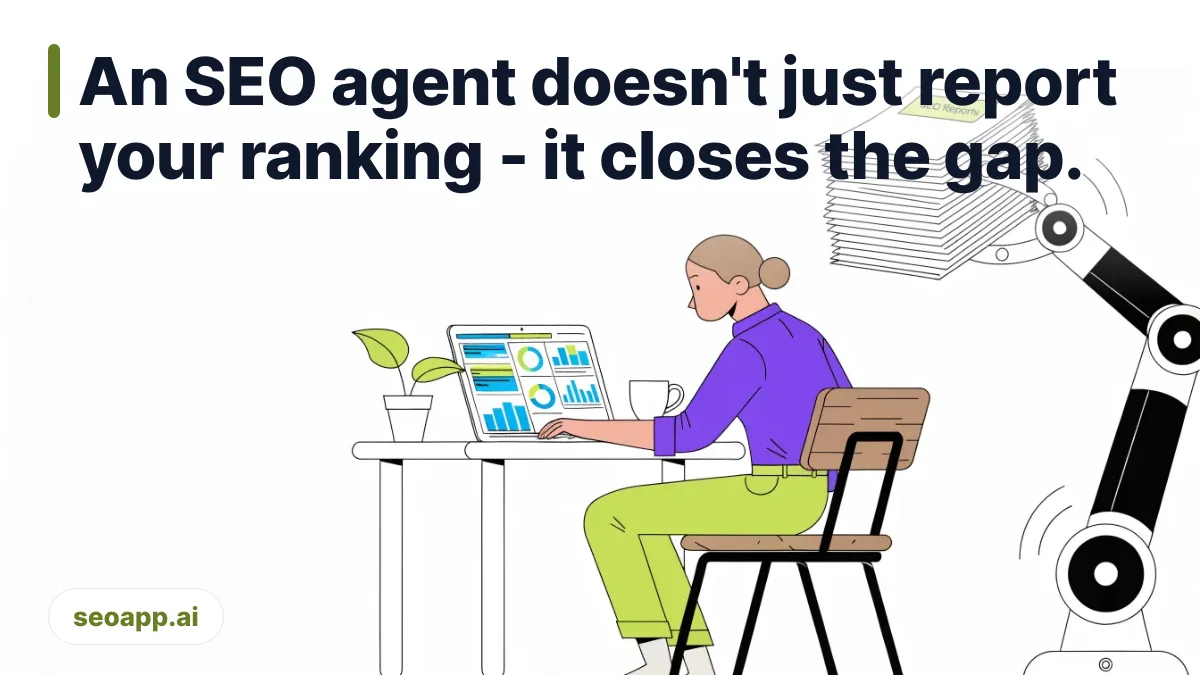
An SEO agent doesn't just report your ranking; it explains the gap and closes it. That's the split between old-school rank trackers and today's agents. Machine learning models predict which changes will move a position before you publish.
Which key factors does an agent evaluate in Google?
Google doesn't publish a single score. So agents reverse-engineer patterns from top-ranking pages and known ranking systems. The factors they weigh most heavily in 2026:
- Content relevance and intent match - does the page answer the query? NLP checks semantic coverage, not just keyword presence.
- Topical depth vs. competitors - subtopic coverage compared against ranking pages.
- Technical health - crawlability, page speed, structured data, mobile rendering.
- Backlink profile - referring domains, anchor diversity, spam signals.
- On-page structure - headings, internal links, entity coverage.
- Freshness and update cadence - how recently the page was revised.
- AI-search visibility - whether ChatGPT, Perplexity, and Gemini cite the page.
That last factor is new and easy to miss. A page can sit at position three yet get ignored by AI answer engines that pull citations from a different set of signals. A serious agent now scores both surfaces-a client can gain AI citations while their classic ranking barely moves, and the other way round.
Which SEO agent platforms handle ranking analysis best in 2026?
The market splits into three groups: full autonomous agents that publish, agentic tools that automate specific tasks, and API layers you build agents on top of. Here's how the main options compare, with our own agent listed first.
| Platform | Best for | Standout feature | Plan |
|---|---|---|---|
| Seoapp.ai | Businesses wanting hands-off Google + AI visibility | Daily optimized articles, tracks Google and LLM citations | Trial available |
| Nightwatch | Rank tracking teams | Granular position tracking and reporting | Paid tiers |
| ClickRank | Automating on-page fixes | AI SEO agent applying page-level changes | Paid tiers |
| SE Ranking API | Developers building custom agents | Live keyword, backlink, domain data via API | 14-day trial |
| Ahrefs | Data-heavy manual analysis | Deep backlink and keyword datasets | Paid tiers |
1. Seoapp.ai - our autonomous SEO and GEO agent
Seoapp.ai is our autonomous agent that analyzes Google rankings and visibility inside AI models like ChatGPT, Perplexity, and Gemini, then produces optimized articles daily.
- Tracks classic ranking and AI-citation status side by side
- Publishes optimized content on a daily cadence
- Targets both Google and answer engines (GEO)
For whom: businesses and founders who'd rather ship content than manage spreadsheets. Start with our SEO agent for business guide.
2. Nightwatch and ClickRank - task-focused agents
Nightwatch leans into precise rank tracking across locations and devices. The ClickRank AI SEO agent applies on-page fixes with approval steps, keeping a human gate. Both AI SEO agents automate sequential tasks like keyword research and content optimization, but you still assemble the strategy.
3. SE Ranking API and Ahrefs - build-your-own layer
The SE Ranking API lets AI agents access live keyword, backlink, and domain data, sold standalone with a 14-day trial. Pair it with a framework and your agent can research keywords and audit sites on its own. Ahrefs suits teams who want the richest dataset and don't mind driving the analysis by hand.
How does an SEO agent analyze competitor rankings?
An SEO agent analyzes competitor rankings by scraping the top results and modeling what winning pages have in common. It's structured reverse-engineering, not copying:
- Pull the SERP - grab the top 10 URLs for each keyword.
- Extract structure - headings, word count, entities, schema, internal links.
- Find the pattern - detect what ranking pages share that yours lacks (missing FAQ, comparison table, deeper coverage).
- Score the gap - machine learning estimates how much closing each gap could move your position.
- Prioritize - ranks fixes by predicted impact.
This is where predictive SEO earns its keep. Instead of publishing and waiting weeks, the agent forecasts likely ranking shifts before the change goes live. Teams stop rewriting pages that were fine and focus on the two or three that held them back. Keyword research automation feeds the loop, surfacing clusters competitors rank for that you've never targeted.
What can an SEO agent do automatically, and where do you still need a human?
An SEO agent automates the repetitive, data-heavy parts-keyword research, competitor audits, content drafting, monitoring-while humans stay in charge of strategy and brand judgment. Many run with human approval steps built in.
Automated well:
- Continuous ranking and performance monitoring
- Keyword and competitor research
- On-page structure and content optimization
- Multi-language and regional SEO
- Real-time analytics and reporting
Still needs a human:
- Deciding brand positioning and tone
- Approving claims in regulated topics
- Judging whether a topic fits the business at all
- Reviewing AI drafts for accuracy before they go live
Automation removes the busywork; it doesn't remove the judgment. An SEO agent works while you sleep, but it works best with a clear brief. Feed it garbage targets and it'll optimize efficiently toward the wrong goal. Our SEO agent works while breakdown covers where that line sits. When the SEO agent works through the night, it queues drafts and fixes so you wake up to a prioritized list rather than a blank page.
Frequently asked questions
What is an SEO agent ranking analysis in simple terms?
An AI-driven review of where your site ranks and why, done automatically. The agent tracks positions, compares you to competitors, spots the gaps, and either recommends or applies fixes. Unlike a plain rank tracker, it acts on the data rather than just displaying it.
Can an SEO agent replace an SEO agency?
For many businesses, it replaces the repetitive execution-research, monitoring, content drafting, and reporting. It won't replace high-level strategy, brand decisions, or judgment on sensitive claims. A practical setup: an agent handles the daily grind while a human sets direction and approves output.
Is there a free SEO AI agent to try?
Several options offer free trials rather than fully free plans. The SE Ranking API includes a 14-day trial, and platforms like ours offer a way to test before committing. Free-forever agents that both analyze and publish at scale are rare, since data and compute cost money.
Do SEO agents optimize for AI search like ChatGPT and Perplexity?
The better ones do. A modern agent scores both Google positions and whether AI answer engines cite your content. This matters because the two surfaces reward slightly different signals.
How accurate is predictive SEO from these agents?
Predictions are estimates, not guarantees-based on patterns from ranking pages and historical shifts. They're reliable enough to prioritize which fixes to make first. Treat forecasts as a ranked to-do list, not a promise of specific positions.
The single most useful thing you can do this week is connect one agent to your Search Console and let it run a full ranking analysis-the gap report alone usually surfaces two or three fixes you'd never have prioritized by hand. If you'd rather skip setup and have both your Google rankings and AI visibility handled on autopilot, that's exactly what we built Seoapp.ai to do. Start with the free run, read the gaps, then decide how much to automate. Waiting another quarter just hands the position to whoever moved first.
Rate this article
People don't just Google anymore - they ask AI 🚀
Grab traffic from Google and AI at once. seoapp.ai writes content that ranks and gets cited by AI - so you stay ahead of the competition.
Try seoapp.ai →